Signs you may need one
Your dentist confirms this with an exam and an X-ray. These are the usual reasons people call us:
- Toothache that keeps coming back
- Pain that wakes you at night
- Sensitivity to hot or cold that lingers
- Swelling or a small pimple on the gum
- A tooth that turned dark after a knock
Some infected teeth give no warning. Your dentist may spot one on a routine X-ray.
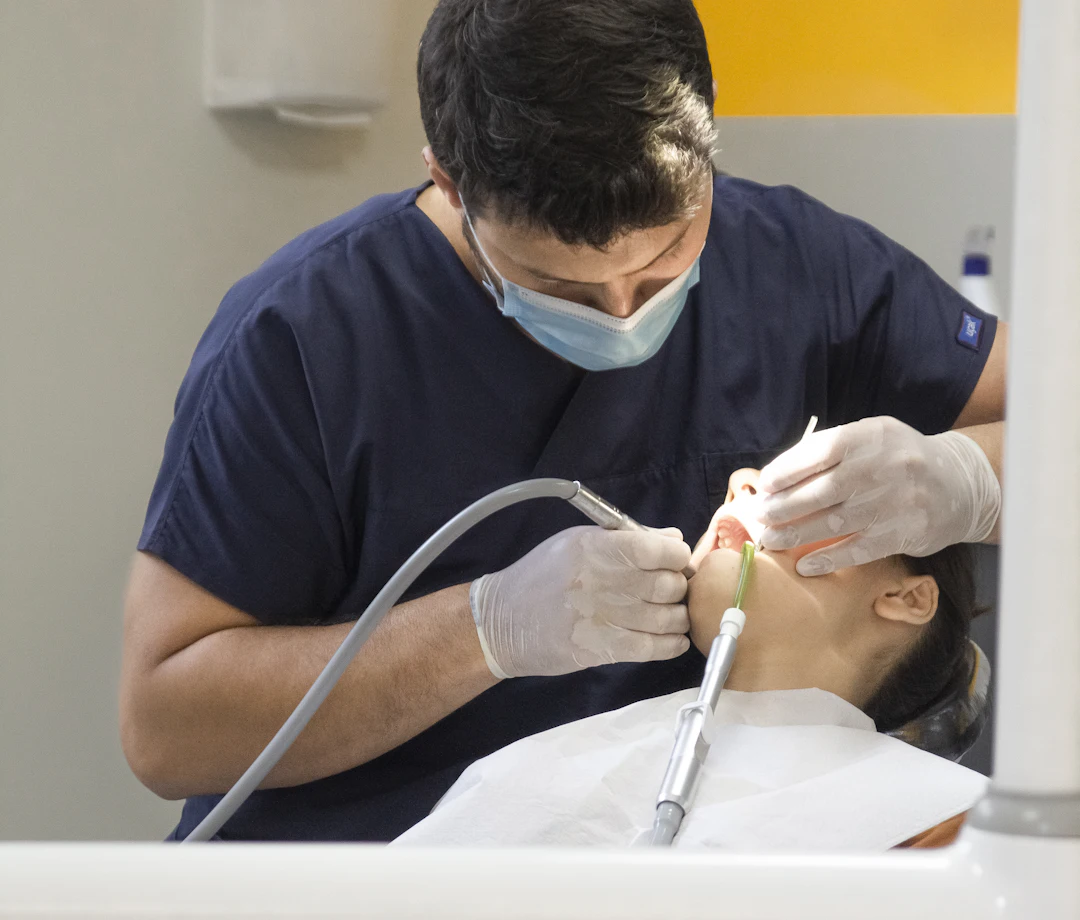
What happens at your appointment
- Exam and X-ray Your dentist checks the shape of the roots and how far the infection has spread.
- Numbing the tooth You get a local anaesthetic before any work begins.
- Cleaning the canals Your dentist removes the infected pulp, then cleans and shapes each canal.
- Sealing the tooth Your dentist fills the canals and closes the tooth. You may need a crown later.
How long it takes
Many root canals take one or two visits. A molar has more canals than a front tooth, so it can take longer.
We are open until 9 PM, so you can come in after work. Ask for an evening slot when you call.
The first few days
Some tenderness is normal. Chew on the other side until your dentist has fully restored the tooth.
Call the clinic if swelling grows or the pain gets worse.
Root canal or extraction?
Your own tooth keeps the bone and the bite around it in place. A gap can let nearby teeth drift.
Some teeth are too damaged to save. Your dentist will show you the X-ray and explain both options.
Tests your dentist may use
Your dentist needs to know whether the nerve is inflamed, infected or already dead. A few quick tests help.
- A cold test on the tooth and its neighbours
- Gentle tapping to check for soreness
- Pressing on the gum to look for swelling
- An X-ray of the roots and the bone around them
The results decide whether you need a root canal, a filling or something else.
Front teeth and back teeth
A front tooth usually has one canal and a straight root. Treatment is often quicker.
Molars at the back can have three or four canals, some curved or narrow. Your dentist takes more time to find and clean each one.
Children’s teeth
Baby teeth can get deep decay too. Instead of a full root canal, dentists often treat only the top part of the nerve.
Keeping a baby tooth until it falls out holds space for the adult tooth underneath. Our dentists see children as part of our general dentistry service.
When a tooth needs more treatment
Most root-treated teeth settle well. A few cause trouble months or years later.
Your dentist may then suggest re-treating the canals. If that is not possible, removing the tooth may be the safer choice.
Pregnancy and root canals
Tell your dentist if you are pregnant or breastfeeding. They will plan any X-rays and medicines with that in mind.
An untreated infection can also affect your health, so do not wait to be seen.
Questions to ask before you start
- Can this tooth be saved, and for how long?
- Will I need a crown afterwards?
- How many visits should I plan for?
- What should I do if the pain comes back?